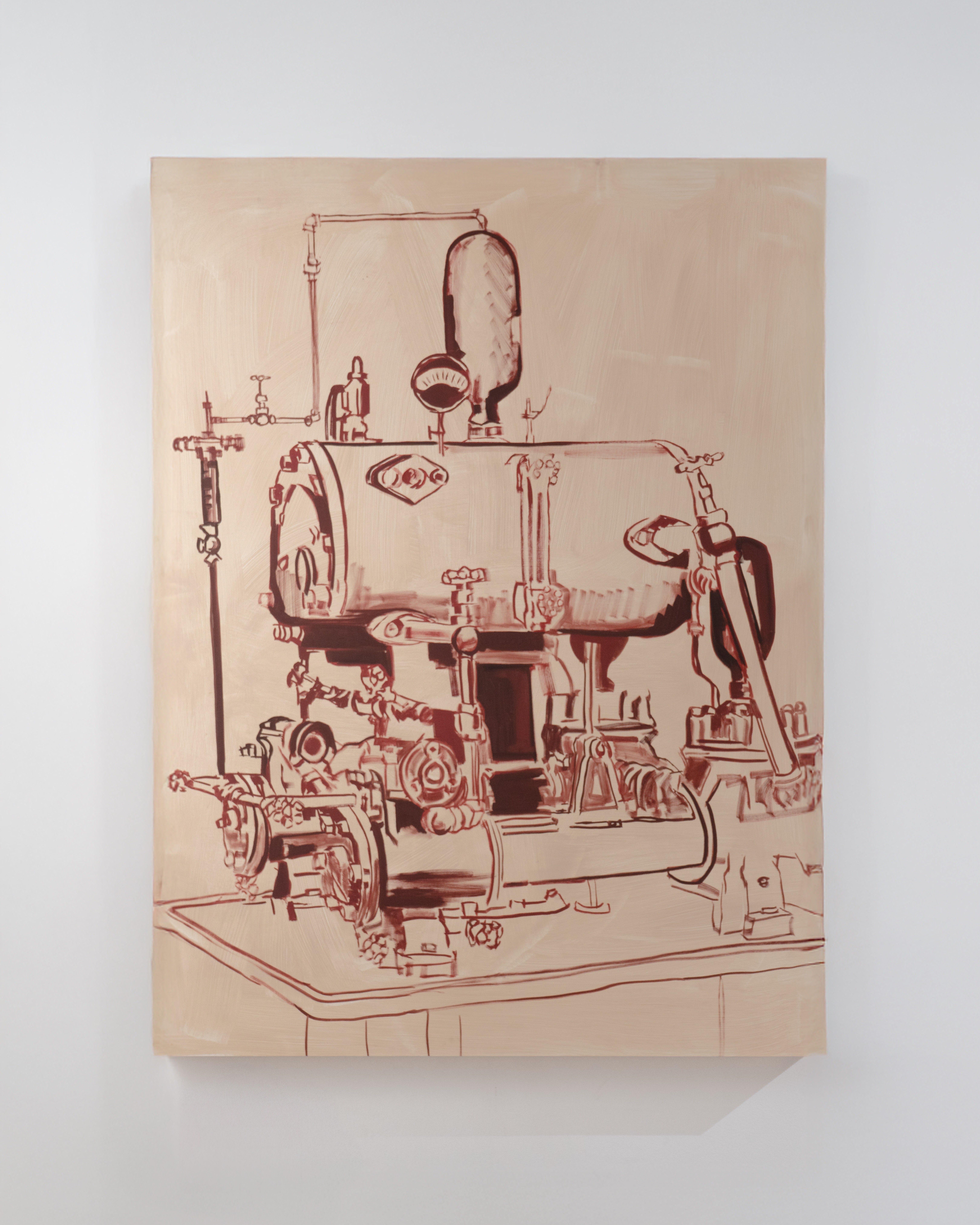
Steam Driven Outfits with Two Single Style "A" Piston Pumps
Steam Driven Outfits with Two Single Style "A" Piston Pumps
Artist
Lauren Safier
Year
2025
Medium
Oil on wood panel
Dimensions
48 x 36 in
Description
In Between Memory and History, Pierre Nora writes, “We speak so much of memory because there is so little of it left.” As lived continuity recedes, memory becomes constructed and spatialized.
The artwork is from a series called Machina Memoriae or Machine Memory. The work are drawn from early twentieth-century catalog illustrations of steam pumps manufactured by the Blake and Knowles Steam Pump Foundry in Cambridge, Massachusetts. These machines once regulated circulation, pressure, and force. They were built in part by Polish immigrant women who shaped sand molds in the foundry’s core rooms under extreme heat and hazardous conditions. Their labor contributed to early labor reforms in Massachusetts, yet their stories did not endure in the same way as the machines themselves. The pumps persist; the workers largely disappear.
The paintings do not reproduce archival images but translate them. Using underpainting techniques derived from early Renaissance grisaille and verdaccio, the works suspend the image between emergence and completion. Monochrome foundations remain visible as color accumulates selectively. The surface holds multiple temporal states at once.
What is typically concealed beneath the finished image is allowed to remain. This persistence functions as a model for historiography: memory appears not as a unified narrative, but as fragments, reconstructions, and partial impressions. Forms solidify and dissolve simultaneously. The viewer cannot determine whether the image is forming or fading. Both conditions coexist.
Gallery
Description
In Between Memory and History, Pierre Nora writes, “We speak so much of memory because there is so little of it left.” As lived continuity recedes, memory becomes constructed and spatialized.
The artwork is from a series called Machina Memoriae or Machine Memory. The work are drawn from early twentieth-century catalog illustrations of steam pumps manufactured by the Blake and Knowles Steam Pump Foundry in Cambridge, Massachusetts. These machines once regulated circulation, pressure, and force. They were built in part by Polish immigrant women who shaped sand molds in the foundry’s core rooms under extreme heat and hazardous conditions. Their labor contributed to early labor reforms in Massachusetts, yet their stories did not endure in the same way as the machines themselves. The pumps persist; the workers largely disappear.
The paintings do not reproduce archival images but translate them. Using underpainting techniques derived from early Renaissance grisaille and verdaccio, the works suspend the image between emergence and completion. Monochrome foundations remain visible as color accumulates selectively. The surface holds multiple temporal states at once.
What is typically concealed beneath the finished image is allowed to remain. This persistence functions as a model for historiography: memory appears not as a unified narrative, but as fragments, reconstructions, and partial impressions. Forms solidify and dissolve simultaneously. The viewer cannot determine whether the image is forming or fading. Both conditions coexist.